
The SPQ – Systemizer Profile Questionnaire – has been developed by Kirsten Callesen and Peter Dyhr, based on Professor Simon Baron-Cohen’s screening tools (AQ Asperger’s quotient, EQ Empathy quotient and SQ Systemizer quotient) as well as questions from the screening tools for detection related to sensory hypersensitivity.
The SPQ is a screening tool and can be used to make a personal profile
Having a Systemiser profile is not a diagnosis or disorder, but merely a narrative way to explain a particular way of functioning. If you are a health professional, you can use the SPQ to ascertain whether there are particular difficulties with functioning  in this way.
Simon Baron-Cohen’s initial screening tools consist of AQ (50 questions), EQ (40 questions) and SQ (75 questions). Of these tools, we have included 20 questions from AQ, 20 questions from EQ and 25 questions from SQ (If you are an HR partner or professional, you can receive the exact questions we have taken from Baron-Cohen’s tests) and 20 questions on social and sensory sensitivity. The SPQ consists of 85 questions total.
Simon Baron-Cohen developed AQ with 5 subcategories (attention to detail, attention to change, social interaction, social communication and social imagination). These categories are also used in the SPQ.
The SPQ scores each question depending on how relevant it is in terms of being a person with a Systemizer profile. If you answer “Systemizer relevant” to a question, you get 1 or 2 points depending on how much you believe it is true or if you answer “Systemizer different”, you get 0 points for a question. The highest total score is 170 points.
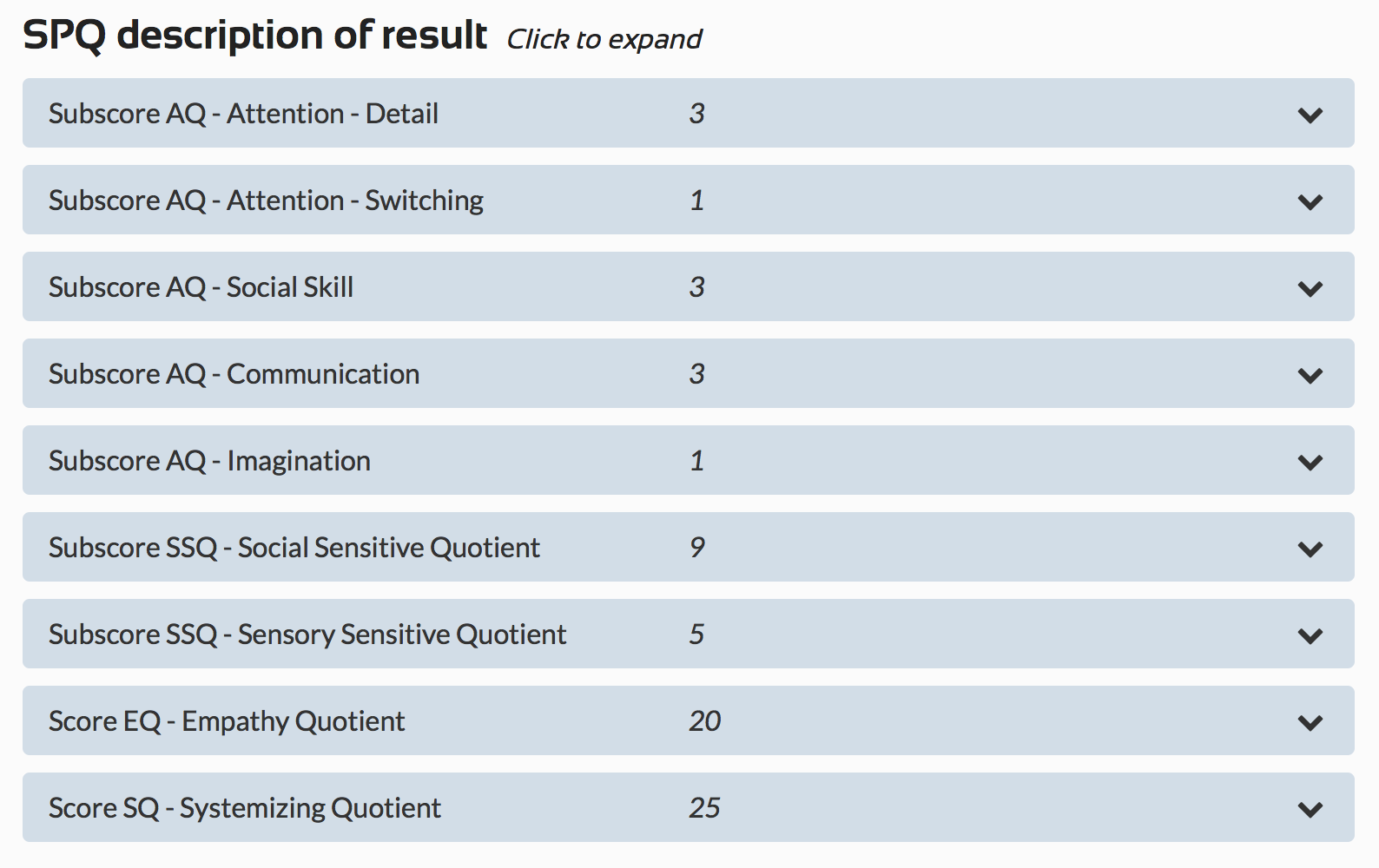 The total score is added up from several subcategories, as you can see from the example.
There are 9 subcategories in the SPQ and each subcategory is divided into three possible scores: a low, median or high score. This means that one can have a low
score in 3 out of 5 AQ subscores and a high score in 2 out of 5 AQ scores. Just as one can have a median score in the EQ section and high scores on the two sensory profile scores, as well as a median score in SQ. It is all completely dependent on what your subscores are, then you will have generated an individualreport that takes your profile into account in general. If you want a custom report with all the questions taken into account, your score must be manually processed, which can be done by contacting a Systemizer consultant.
Scoring of AQ section
There are four questions from each of the 5 subcategories from AQ (20 issues in all), meaning you can get up to 8 points for each subcategory, together providing up to 40 points. After taking the test you get an automatically generated report, taken from the individual scores of the subcategories. In Simon Baron-Cohen’s original AQ test, you got 1 point regardless of whether the answer fit a little or a lot and 0 points if the answer did not fit. In the SPQ we have weighted the answers to two points if the answer fits very well, 1 point if the answer fits somewhat and 0 points if the answer does not fit.
Scoring of AQ section
There are 2 sensory profiles within the SPQ. One we call Social Sensitive. It includes 10 questions that focus on the fact that a human being can be particularly sensitive to external interference by other people in their life, without this in itself involving problems with empathy or their ability to see another’s point of view. It is mostly that they become exhausted by too much social contact and need time to themselves. It is possible to be either introverted or extroverted while also being social sensory sensitive. The highest subscore is 20 points. The second we call Sensory Sensitive. It focuses on actual sensory integration problems in the form of sound, touch, smell, light and flavour. If you score high on the Sensory Sensitive part of the SPQ, then you become tired of being in environments where you experience challenges to your sense filter, requiring time to recover alone or in environments that seem more objective. The highest score for this subcategory is 20 points. All together it is possible to score a high of 40 points in SSQ.
Scoring of EQ section
There are 20 questions from EQ with a possible maximum of 40 points. In Baron-Cohen’s original EQ questions were scored by how few points you got. The lower the score, the more challenges with empathy. In the SPQ version we have switched the answers around, meaning that the higher the score on EQ questions, the greater the challenges in relation to empathy.
Scoring of SQ section
There are 25 questions from SQ, with a possible maximum of 50 points. The more you can figure out, calculate, make use of, have an easy time with, seek out or see through logical systems and knowledge, the higher your score. Part of the SQ hides a small organiser profile. One can be a Systemizer and be good at both logical systems and systems revolving around social and human systems, such as arranging events. Or you may score most on the organisation questions, so that your score reflects the ability and desire to organise things rather than also being attracted to logical and knowledge-based content.
Why was the test made?
There are many people who would find it useful to increase their self-awareness and who work in environments where it would be useful to increase knowledge about these particular individuals’ ways of functioning. In our work as consultants we have repeatedly needed to screen people with highly specialised talents, but who have had certain challenges functioning in social settings.
Based on Simon Baron-Cohen’s Systemizer theory (The Extreme Male Brain), we introduce the Systemizer profile, consisting of different facets. If you have certain traits of the autism profile, if you are challenged by empathy, if you are vulnerable to sensory input and if you have a strong ability to systematize, then there is a high probability that you have a Systemizer profile. The SPQ screens for this particular profile.
Background story
Many years ago Daniel Goleman published the book Working with Emotional Intelligence, where he describes the advantage of having a high degree of emotional intelligence in the context of the labour market and where he describes the challenges of those employees who do not have high levels of emotional intelligence.
Over the last decades a large amount of literature has been released on the particular importance of empathy, emotional intelligence and other social strategies considered to be important competitive parameters in order to succeed as an employee and as a company.
At the same time it has become equally clear that there is a group of employees who have less desire or ability for the social, or less ability or desire to use empathy in social contexts. This group of employees can be pressed by the demands of social intelligence and can be put out at work if their special talents or abilities are not being recognised.
With the SPQ, Systemizer wants to create a language and a way for those with a Systemizer profile to succeed both professionally and personally and make use of their extraordinary talent within their area of expertise for the benefit of all.